






























Rwanda Releases Monetary Policy and Financial Stability Statement
Rwanda's latest monetary policy statement outlines the central bank's approach to economic conditions, price stability and the resilience of the financial sector

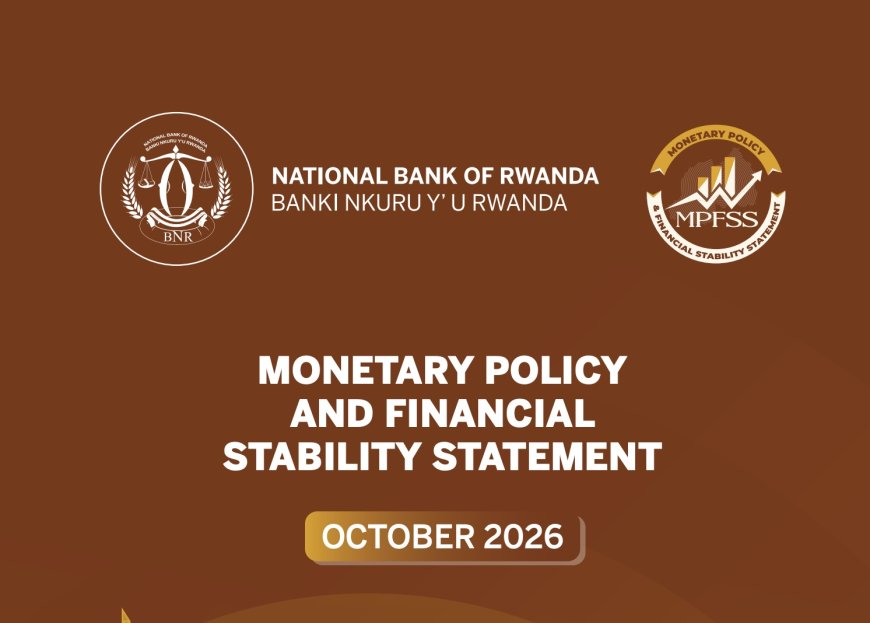
The October 2026 Monetary Policy and Financial Stability Statement (MPFSS) aims to assess economic and financial developments during the first half of 2026 and to provide an outlook for the rest of the year.
The IMF’s July 2026 World Economic Outlook projects global growth to slow from 3.5 percent in 2025 to 3.0 percent in 2026 and to 3.4 percent in 2027, below the pre-pandemic historical average of 3.8 percent. Higher energy costs are weighing on economic activity, particularly in energy-importing economies, although high investment linked to artificial intelligence is partly offsetting the slowdown.
In the first half of 2026, the global commodity price index rose by 18.6 percent and is projected to further increase in 2026, reflecting higher energy and food prices. As a result, global annual average inflation is projected to increase to 4.7 percent in 2026, up from 4.1 percent in 2025 and expected to remain above the pre-pandemic average of 3.5 percent in 2017-19 period.
With inflation pressures renewed, the outlook for monetary policy in advanced economies has become more cautious, adopting a restrictive stance, either holding interest rates steady or introducing precautionary hikes as they assess whether higher energy prices will lead to sustained inflation. Domestically, Rwanda’s economy maintained strong momentum in the first half of 2026, with real GDP rising by 9.7 percent year-on-year.
Growth was underpinned by robust performance in services, particularly trade and transport, financial services, information and communications. Industry also contributed strongly, supported by higher mineral export values reflecting favorable international prices, continued investment in public and private construction projects, and growth in manufacturing, particularly food processing and spillover effects from construction activities.
8 Agricultural growth was moderate, reflecting weaker-than-expected harvests from Seasons A and B of 2026. In the first half of 2026, Rwanda’s merchandise exports increased by 52.1 percent to USD 1,256.5 million, driven mainly by higher mineral and other export receipts. Imports rose by 18.9 percent to USD 2,808.5 million, reflecting increased demand for food, construction materials and manufacturing inputs. Consequently, the trade deficit widened slightly by 1.1 percent to USD 1,552.0 million, while the export-to-import ratio improved from 35.0 percent to 44.7 percent.
By the end of June 2026, the Rwandan franc weakened modestly by 0.87 percent against the U.S. dollar, well below the 2.96 percent depreciation recorded in the same period of 2025. Stronger remittances and merchandise exports both slowed the depreciation and supported gross official reserves, which stood at 4.1 months of prospective imports during the first half of 2026. Money market interest rates increased in the first half of 2026, reflecting the tightening of monetary policy that began in August 2025 and continued in February and May 2026.
The tightening was particularly pronounced in the first half of 2026, when the MPC raised the Central Bank Rate (CBR) by 50 basis points to 7.25 percent in February and by a further 100 basis points to 8.25 percent in May. These increases were intended to contain rising inflationary pressures and steer inflation back within the target range. As a result, the interbank rate increased by 89 basis points, averaging 7.43 percent in the first half of 2026, compared with 6.54 percent in the corresponding period of 2025. By contrast, the weighted average deposit rate declined by 12 basis points to 9.48 percent, from 9.60 percent a year earlier. Similarly, the lending rate declined by 15 basis points to 15.78 percent, from 15.93 percent over the same period. This suggests that the recent increases in the CBR have not yet been reflected in retail interest rates.
9 Headline inflation increased to 11.2 percent in the first half of 2026 year-onyear, up from 7.3 percent recorded in the second half of 2025. This increase was driven by an increase in core, fresh food and energy inflation.
Core inflation rose mainly due to an increase in core transport and core housing inflation which offset the decrease in core food and core hotels and restaurants. Fresh food inflation rose, largely reflecting higher inflation in fresh vegetables which offset a decline in fresh fruit inflation, while energy inflation increased, mainly due to higher prices of charcoal, liquid fuels, and electricity. Looking ahead, headline inflation is projected to remain above the 2–8 percent target range in the second half of 2026. It is expected to average 13.1 percent in 2026, before easing to 7.9 percent in 2027. The outlook is subject to upside risks.
Adverse weather, including a possible El Niño episode, and higher fertilizer prices could reduce agricultural output and raise food prices. Continued uncertainty in the Middle East could also push up international oil and food prices, increasing imported inflation and feeding through to other consumer prices. If these risks materialize, inflation could remain above the target range for longer than projected. Against this backdrop, the Monetary Policy Committee (MPC) remains committed to price stability, will continue to monitor risks to the inflation outlook, and adjust the monetary policy stance as needed to bring inflation back within the target range.
Rwanda’s financial sector remained stable and resilient during the first half of 2026, providing a solid foundation for continued economic activity. Strong capital and liquidity buffers, sustained profitability and continued growth across major financial subsectors supported the sector’s capacity to serve households and businesses.
Geopolitical tensions, particularly in the Middle East, continue to pose potential risks through higher fuel and transport costs, import prices, supply-chain disruptions and weaker external demand. However, no material impact on the stability of Rwanda’s financial system has been observed so far, while relatively limited direct exposure to global financial markets helps contain the transmission of external financial shocks. The financial sector continued to expand, with total assets increasing by 22.7 percent year-on-year to FRW 17.5 trillion.
Growth was supported by strong deposit mobilization, increased pension contributions, higher insurance premiums and investment income, and retained earnings, strengthening the resource base available to support financial intermediation and investment.